


water softener
Whole House Water Filter Vs Water Softener: Which Do You Need?
A whole house water filter catches sediment and chlorine taste. A water softener removes hardness. Here is how to tell which one your home needs, and when to have both.
- Juan Molina
- 4 min read
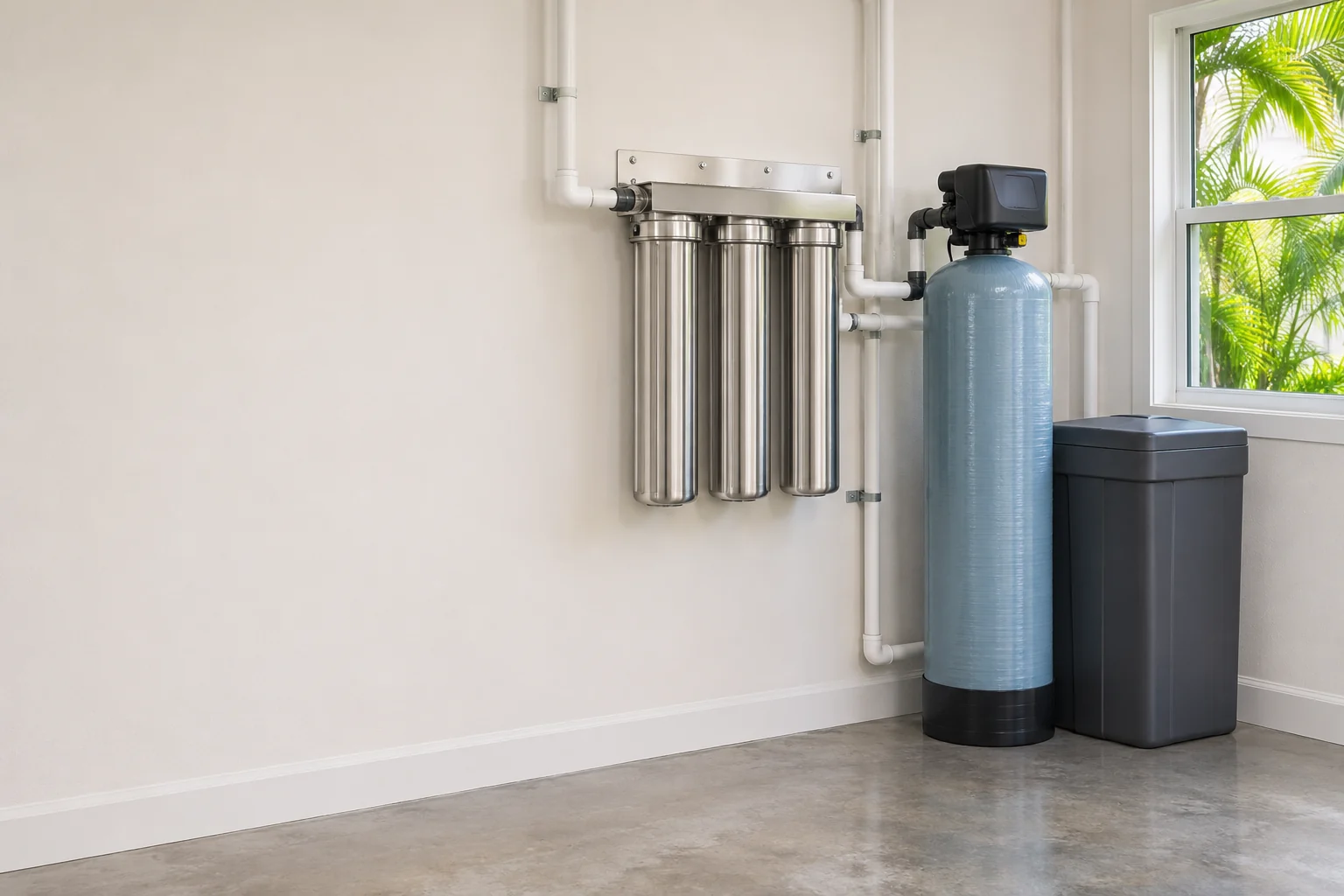
A whole house water filter and a water softener do different jobs. A whole house water filter traps things in the water, like sediment and the chlorine taste and smell. A water softener takes out the calcium and magnesium that make water hard. One does not replace the other. I have been putting water systems into South Florida homes since 2005, and the most common mix-up I hear is a homeowner who bought one expecting it to do the other one's job. Here is how to tell which you need, and when it makes sense to have both.
The Short Answer
- Your problem is taste, smell or grit? That points to a whole house water filter.
- Your problem is white crust, spotty glasses and soap that will not rinse? That points to a water softener.
- You have both? Many South Florida homes do, and the two systems are often installed together.
The only way to know for sure is to test the water coming out of your own tap, which is why we start every visit with a water quality test.
What a Whole House Water Filter Does
A whole house filter sits where the water line enters your home, so every tap, shower and appliance gets filtered water. It works by passing water through stages of filter media, and each stage catches something different.
The H2O-MU110UF system we install is a good example of how the stages stack up:
- Stage 1: a 40-micron stainless steel pre-filter for sand, rust flakes and other sediment.
- Stage 2: a 0.01-micron ultrafiltration stage for much finer particles.
- Stage 3: a 5-micron carbon block, which is the part that deals with the chlorine taste and smell.
What a filter like this is not designed to do is soften water. The hardness minerals are dissolved in the water, not floating in it as particles, so most of them pass right through filter media.
What a Water Softener Does
A softener uses ion exchange. Water flows through a tank of resin beads that hold on to calcium and magnesium and release sodium or potassium in their place. When the beads fill up, the system rinses them with salt brine and starts over. I walk through that cycle in more detail in how a water softener works.
A softener is built for hardness. Penn State Extension puts it plainly: water softeners will not necessarily remove the more serious drinking water contaminants. So a softener on its own is not a filter, and it does not change how your water tastes or smells.
Side by Side
- Main job. Filter: catch sediment and reduce chlorine taste and odor. Softener: remove hardness minerals.
- How it works. Filter: water passes through filter media. Softener: ion exchange in a resin tank.
- What you notice. Filter: water that tastes and smells cleaner, less grit in aerators. Softener: less white scale on fixtures, fewer spots, soap that rinses off.
- Upkeep. Filter: cartridges are changed on a schedule. Softener: salt is added to the brine tank and the system regenerates on its own.
- Water use. Filter: none beyond normal flow. Softener: each regeneration sends water to the drain.
Signs You Need a Filter, a Softener, or Both
These are the clues I look for when I walk into a home.
- Chlorine smell from the shower or tap water that tastes like a pool: a filter question.
- Grit in faucet aerators or brownish sediment in the toilet tank: a filter question.
- White crust on faucets and shower heads, cloudy glassware and a film on the shower door: a hardness question. The signs of hard water post covers these in detail.
- Both sets of clues: you likely need both systems, and the test result tells us how to size them.
Can You Have Both?
Yes. In a lot of homes we work in, the water has chlorine from treatment and hardness from the aquifer at the same time, so one system only solves half the problem. When both go in, the filter and the softener are installed on the main line, one after the other, so all the water in the house passes through each.
If you already have one system and still see the other problem, that is usually the reason. A softened house can still smell like chlorine, and a filtered house can still get crusty faucets.
Why We Test Before We Recommend
Two houses on the same street can have different results, depending on the pipes, the water heater and how the water reaches the home. So we do not guess. We test the actual tap water on site, show you the numbers, and then recommend a filter, a softener, both, or neither. Some homes only need reverse osmosis at the kitchen sink or a shower filter, and we say so.
Most of our installations take 4 to 6 hours, and we often book the same week you call.
Where We Work
We are based in Miami and install whole house filters and softeners across Miami-Dade, Broward and Palm Beach counties. If you are not sure which system your home needs, reach out and we will set up a time to test your water and talk it through.