

water softener
How Does A Water Softener Work? Ion Exchange Explained
A water softener swaps the calcium and magnesium in your water for sodium or potassium. How ion exchange works, how the softener resets itself, and what it is not designed to do.
- Juan Molina
- 3 min read
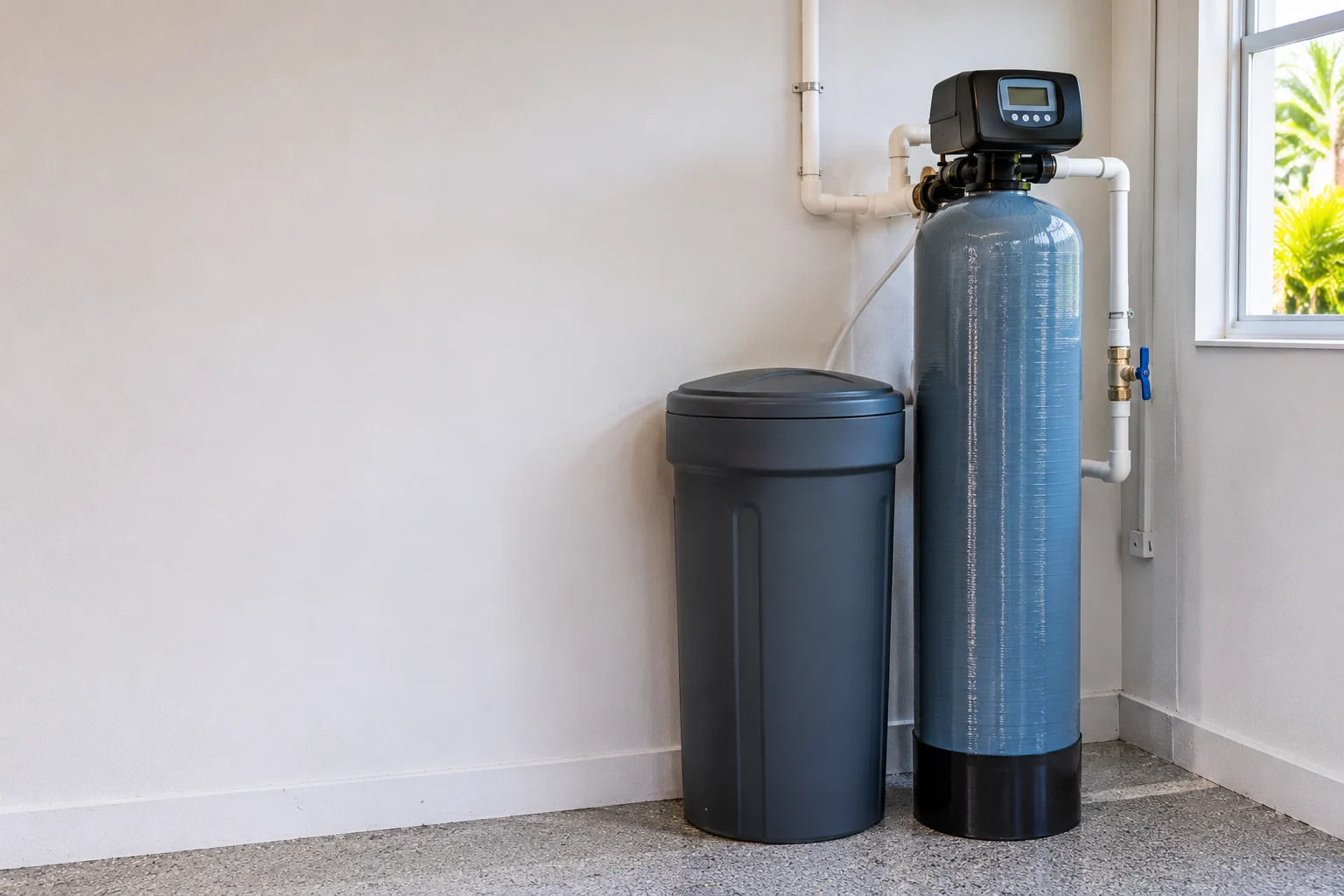
A water softener takes the calcium and magnesium out of your water and swaps them for sodium or potassium. Those two minerals are what make water "hard," and they are behind the white crust on faucets and the film on shower doors. Here is how the swap happens inside the tank, what keeps it working, and what a softener is not designed to do.
What Hard Water Is
Hard water is water with a lot of dissolved calcium and magnesium. According to Penn State Extension, these minerals are not a health concern, but they leave scale in pipes and appliances and make soap harder to rinse off. Hardness is measured in grains per gallon (gpg) or parts per million (ppm), and one grain per gallon is about 17 ppm.
Penn State's scale looks like this:
- Soft: under 1 gpg
- Slightly hard: 1 to 3.5 gpg
- Moderately hard: 3.5 to 7 gpg
- Hard: 7 to 10.5 gpg
- Very hard: over 10.5 gpg
If you are not sure where your home falls, our post on the signs of hard water covers what to look for, and a water quality test gives you an actual number.
How A Water Softener Works: Ion Exchange
Most home softeners use a process called ion exchange. The main tank is filled with resin, a sand-like material made of tiny beads. Each bead is coated with sodium ions, which carry a positive charge.
Calcium and magnesium also carry a positive charge, and the resin holds on to them more strongly than it holds sodium. So as hard water flows through the tank, the beads grab the calcium and magnesium and let go of sodium in their place. The water that comes out the other side has far less hardness in it.
Regeneration: How The Softener Resets
The resin can only hold so much. Once the beads are full of calcium and magnesium, they stop softening. The softener then runs a cycle called regeneration:
- Salt in a second tank, the brine tank, dissolves into a strong salt solution.
- The brine is flushed through the resin, where the high concentration of sodium pushes the calcium and magnesium off the beads.
- The hardness minerals and leftover brine are rinsed to the drain.
- The beads are coated in sodium again and ready to soften.
Penn State notes that each regeneration uses about 50 gallons of water, which is worth knowing if your home is on a septic system.
Sodium Or Potassium
Because the exchange swaps hardness for sodium, softened water has a little more sodium in it. Penn State puts it at about 7.5 milligrams per quart for each grain per gallon of hardness removed, and suggests people on a low sodium diet keep that in mind. Some softeners can run on potassium chloride instead of salt, which swaps the hardness for potassium.
What A Softener Is Not Designed To Do
A softener is built for hardness. It is not a general purpose filter, and Penn State points out that it will not necessarily deal with more serious drinking water contaminants. That is why many homes pair it with other equipment:
- Whole house filtration for chlorine, sediment and taste across every tap
- Reverse osmosis under the sink for drinking water
- PFAS reduction where testing shows it is a concern
- Shower filtration for the bathroom
Iron is a special case. Penn State notes that dissolved iron can be handled by a softener, but iron that has already oxidized (the reddish kind) can clog the resin, so it is usually filtered out first.
Keeping A Softener Working
- Keep the brine tank stocked with salt or potassium.
- Watch for mud or sediment, which can coat the resin. Pre filtration helps.
- Follow the manufacturer's cleaning schedule for the resin.
Is A Softener Right For Your Home?
That depends on how hard your water actually is and what else is in it. H2O In Home works with homes across Miami-Dade, Broward and Palm Beach. You can read about our water softener installation, browse whole house systems, or book a water test to see your numbers before you decide anything.